
Introduction
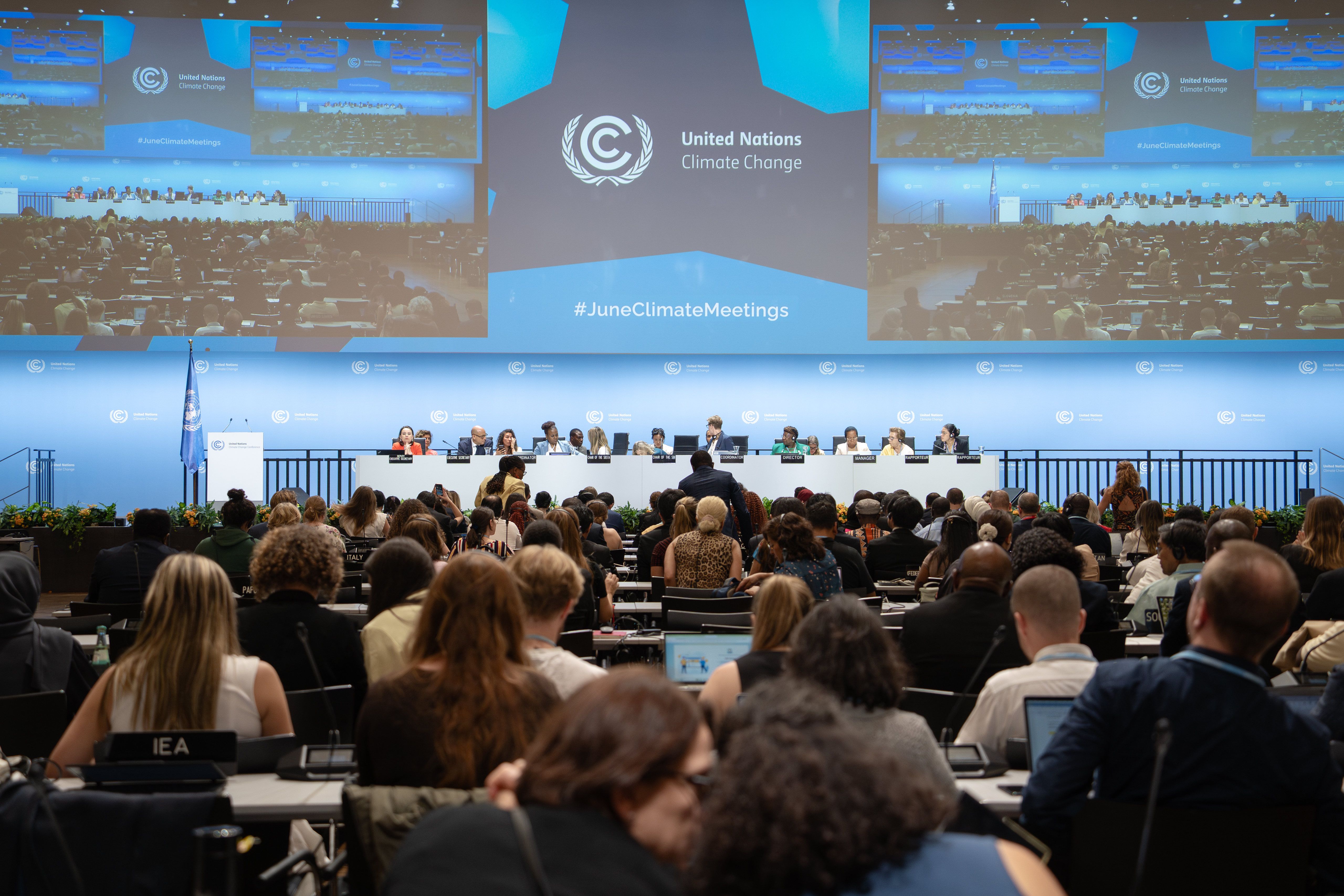
SB64 highlighted the increasing shift of climate governance from rule-making toward implementation, with negotiations focused on operationalizing existing commitments and strengthening institutional arrangements across mitigation, adaptation, finance, and related areas. The session reflected the growing complexity of climate governance, as well as the expanding scope of implementation-focused workstreams across both technical and political tracks.
Discussions were characterized by differing interpretations of mandates, procedural arrangements, and the sequencing of work under existing decisions. While Parties broadly reaffirmed the importance of advancing implementation, views diverged on how established frameworks should be operationalized, particularly in balancing technical processes with political considerations.
SB64 highlighted both the progress and challenges of moving from negotiation to implementation. While Parties continued to advance key workstreams, persistent differences on governance, finance, and institutional arrangements demonstrated that translating agreed mandates into practical outcomes remains a central challenge for climate governance.
Adaptation
SB64 adaptation discussions focused on operationalizing the Global Goal on Adaptation (GGA) following the adoption of 59 indicators, with Parties engaging on taskforce design, metadata and methodology refinement, and links between implementation and reporting systems. Despite sustained negotiations, agreement could not be reached on key institutional questions, particularly whether the taskforce should be party-driven or expert-led, and how the GGA framework should interact with broader Paris Agreement processes.
Negotiations also exposed persistent divisions on the role of finance within the GGA, especially regarding references to Article 9.1 and calls for scaling up adaptation finance. Developing countries pushed for direct linkage between GGA implementation and predictable financial support, while others argued finance issues should remain within separate tracks. These differences prevented convergence on text, leaving SB64 without substantive outcomes and highlighting deeper tensions between technical design and political agreement on adaptation governance.
Mitigation
The Mitigation Work Programme (MWP) is designed to maintain ongoing attention to mitigation ambition between Global Stocktakes (GST) through annual dialogues and investment-focused events. It complements the GST cycle by keeping emissions reduction discussions active within the UNFCCC process. At SB64, Parties disagreed on the programme’s focus whether it should primarily support NDC implementation or more directly advance GST outcomes as well as on its duration, including whether it should extend beyond 2030 or remain tied to the “critical decade.” Parties also could not agree on the form of the outcome, with differing views on whether discussions should be captured in a substantive summary or through procedural conclusions only.
SB64 also exposed a deeper structural gap in the MWP which is the absence of a clear pathway from dialogue to implementation. While the programme enables exchange on mitigation opportunities, investment needs, and sectoral approaches, it does not yet translate these discussions into concrete political or policy signals at national level. The disagreement over whether the MWP should “support” or “drive” GST outcomes reflects this unresolved role within the Paris architecture. For COP31, the central question is therefore not only whether to continue the MWP, but how to define its function and ensure its outputs meaningfully influence mitigation action beyond the negotiation space.
Climate Finance
Climate finance negotiations at SB64 focused on the effectiveness and future direction of the UNFCCC’s financial architecture. Discussions covered the Standing Committee on Finance (SCF) review, the Adaptation Fund transition, the climate finance work programme, Article 2.1(c) finance flow alignment, and climate finance reporting. While some procedural progress was made, significant differences remained on the Adaptation Fund transition and the future scope and modality of the climate finance work programme, highlighting broader debates over how climate finance should be governed and delivered.
These dynamics reflect a broader structural tension in climate finance governance, which is increasingly misaligned with the complexity of contemporary finance systems. Beyond traditional public finance, climate finance now spans private capital mobilization, blended finance, and domestic fiscal alignment, while the UNFCCC architecture remains fragmented across funds and bodies. SB64 revealed no convergence on reform direction while some Parties emphasized deeper institutional integration, others preferred maintaining separation for flexibility, while others stressed that the core constraint is insufficient finance rather than architecture. For COP31, the key challenge will be balancing adequacy and coherence on how COP guidance interfaces with the Green Climate Fund, how emerging finance flows are reflected within UNFCCC processes, and how private and South–South finance are positioned within the broader system.
Just Transition
Just transition remained an important area of discussion at SB64 as Parties began considering how to operationalize the newly established Just Transition Mechanism (JTM). Progress was limited, with differing views on the mechanism’s form, functions, and relationship to existing UNFCCC institutions. However, Parties were able to agree on the terms of reference for the review of the Just Transition Work Programme (JTWP), providing a basis for further discussions ahead of COP31.
The negotiations highlighted the challenge of translating the concept of just transition into an operational framework. Because just transition cuts across labor, energy, social protection, and economic development, Parties continue to hold different views on what role the UNFCCC should play. As discussions move toward COP31, attention is likely to focus on how the JTM can support equitable transition pathways through coordination, knowledge sharing, and stronger integration of finance, technology, and capacity-building support.
Trade
Trade is emerging as one of the most politically sensitive frontiers of climate governance. As countries increasingly adopt climate-related trade measures including carbon border adjustments, sustainability standards, and industrial policy interventions, SB64 marked the beginning of a dedicated dialogue on how climate and trade agendas interact within the multilateral system. Discussions focused on concerns around unilateral measures, the need for greater international cooperation, and differing interpretations of how climate action should align with principles of an open and supportive international economic system.
Beyond the substance of trade measures themselves, SB64 exposed an emerging governance question on what role should the UNFCCC play in addressing climate-trade tensions? While some Parties pushed for stronger institutionalization through reports, dedicated workstreams, or standing agenda items, others emphasized the dialogue's limited and non-negotiating mandate. The debate reflects broader concerns that climate policies developed outside the UNFCCC increasingly shape development pathways, competitiveness, and access to markets. As climate and trade become more closely linked, future negotiations may increasingly focus not only on emissions reductions, but also on the economic implications of climate action and the governance frameworks needed to manage them.
Agriculture
Agriculture and food security are gaining increasing attention under the UNFCCC agenda, with SB64 focusing on the second annual synthesis report, a workshop on systematic approaches to food systems, and updates on the online agriculture portal. Parties also reviewed how constituted bodies and financial mechanisms are integrating agriculture-related climate action into their work, including through coordination across adaptation, mitigation, and means of implementation. Discussions further touched on the need to strengthen coherence between technical work, finance delivery, and national implementation priorities in the agriculture sector.
Negotiations exposed a recurring tension between the scale of implementation challenges in agriculture and the limited scope of agreed outcomes. Many interventions stressed barriers related to finance access, trade-related constraints, subsidy structures, and loss and damage impacts on food systems, arguing that these issues are central to effective implementation but remain only partially reflected in the current framing. This gap between identified needs and negotiated outcomes continues to shape agriculture discussions under the UNFCCC, where recognition of challenges has not yet translated into stronger operational commitments.
Capacity-Building
Parties advanced the fifth review of the capacity-building framework under the Convention and Kyoto Protocol, alongside the initiation of the sixth review for Economies in transition (EITs). The process builds on prior mandates from SBI 62 and SBI 63, with a focus on assessing implementation gaps, updating existing frameworks, and aligning capacity-building support with evolving Paris Agreement requirements. Discussions also addressed the relationship between formal capacity-building frameworks and broader implementation needs emerging across adaptation, mitigation, and means of implementation.
A recurring feature across the capacity-building discussions was broad convergence on the importance of strengthening support, but with limited willingness to introduce structural change. While Parties acknowledged persistent gaps in delivery, coordination, and institutional strengthening, responses remained focused on incremental tools such as workshops, periodic reviews, and continued reporting cycles. This indicates that capacity-building is not contested in principle, but constrained in practice, with progress depending more on improving coherence across existing mechanisms than on redesigning the framework itself.
Action for Climate Empowerment (ACE)
As climate action increasingly depends on societal engagement and behavioral change, the ACE agenda has become an important bridge between climate policy and public participation. At SB64, Parties initiated the midterm review of the ACE Work Programme, assessing progress across education, training, public awareness, access to information, and international cooperation. Discussions drew on outcomes from the ACE Dialogue and technical workshop, with attention focused on implementation gaps and priorities for a future action plan.
Across the review, emphasis remained on strengthening practical implementation capacity within existing structures rather than revising the ACE framework itself. Parties highlighted the need to improve access to financial and technical support, reinforce the role of national ACE focal points, expand training opportunities for educators, and strengthen Secretariat-led capacity-building efforts. Proposals also included linking capacity-building activities more closely with regional processes and improving participation of focal points in UNFCCC meetings. While there was broad agreement on the importance of scaling implementation support, Parties only agreed to continue work on the basis of an informal note, with submissions and a synthesis report expected for SB65.
The Youth Print Assessment
SB64 reflects a climate governance system that is institutionally well-developed but still marked by ongoing political and implementation divides. Across mitigation, adaptation, finance, capacity-building, and related workstreams, Parties continued to engage through an already extensive set of mechanisms under the Paris Agreement. While the technical architecture has expanded significantly over time, discussions showed that agreement on how to translate these frameworks into clear and workable implementation pathways remains uneven, particularly where questions of finance and institutional roles arise.
Across many agenda items, a similar pattern also emerged while progress was often made on procedural steps such as continuing mandates, initiating reviews, or advancing dialogues, while more substantive outcomes proved harder to reach. This was most evident in areas where expectations differ on scope, institutional design, and means of implementation, including adaptation governance, climate finance, and just transition. These dynamics point less to a lack of engagement and more to the complexity of aligning diverse national priorities within shared global frameworks.
Looking ahead, COP31 and subsequent processes will be an important moment to strengthen how the system moves from negotiation to delivery. The focus may increasingly shift toward making existing mechanisms work more coherently together, ensuring that technical progress is matched by practical implementation on the ground. This includes improving coordination across finance, technology, and capacity-building, as well as placing greater emphasis on decisions that can be operationalized in practice. COP31 offers an opportunity to support this transition in a way that is steady, inclusive, and responsive to different national circumstances, while keeping the overall direction of implementation clearer and more connected.