
Introduction
The adoption of the Global Goal on Adaptation (GGA) under the Paris Agreement marked a historic step in global climate governance, placing adaptation alongside mitigation as a central pillar of international climate action. While the goal established a shared global ambition to enhance adaptive capacity, strengthen resilience, and reduce vulnerability to climate change, translating that ambition into an effective implementation framework has remained one of the most politically and technically complex challenges under the UNFCCC. Questions of measurement, governance, finance, and accountability continue to shape the evolution of the global adaptation agenda.
COP30 in Belém represented a major milestone in addressing these challenges. Through the adoption of the Belém Adaptation Indicators and the launch of the Belém–Addis Vision on Adaptation (BAVA), Parties established the foundations for operationalizing the GGA and measuring collective progress on adaptation. However, the negotiations also exposed persistent differences over how adaptation should be measured, governed, and supported. These unresolved issues came to the forefront at SB64 in Bonn, where efforts to operationalize the Belém outcomes reached a procedural impasse under Rule 16, deferring negotiations to COP31 in Antalya.
Despite the deadlock in Bonn, the foundations established in Belém remain intact, and the adaptation agenda continues to advance toward COP32 in Addis Ababa. The challenge is no longer whether a global framework for adaptation exists, but whether Parties can build the political consensus needed to implement it effectively.
This paper argues that the evolution of the Global Goal on Adaptation has entered a new phase. The central challenge is no longer designing a global adaptation framework, but building the political consensus required to operationalize it. The journey from Belém to Bonn demonstrates that the future of the GGA will depend not only on technical methodologies and indicators, but also on resolving the governance and finance questions that underpin effective adaptation action.
The Evolution of the Global Goal on Adaptation
The journey toward COP30 in Belém reflects more than a decade of efforts to elevate adaptation within global climate governance. While the impacts of climate change have intensified, adaptation has historically faced a persistent challenge. While mitigation progress can be measured through emissions reductions, adaptation outcomes are highly context-specific and shaped by national circumstances, vulnerability, capacity, and access to resources. This complexity has made defining, measuring, and tracking global progress in adaptation one of the most challenging issues in international climate negotiations.
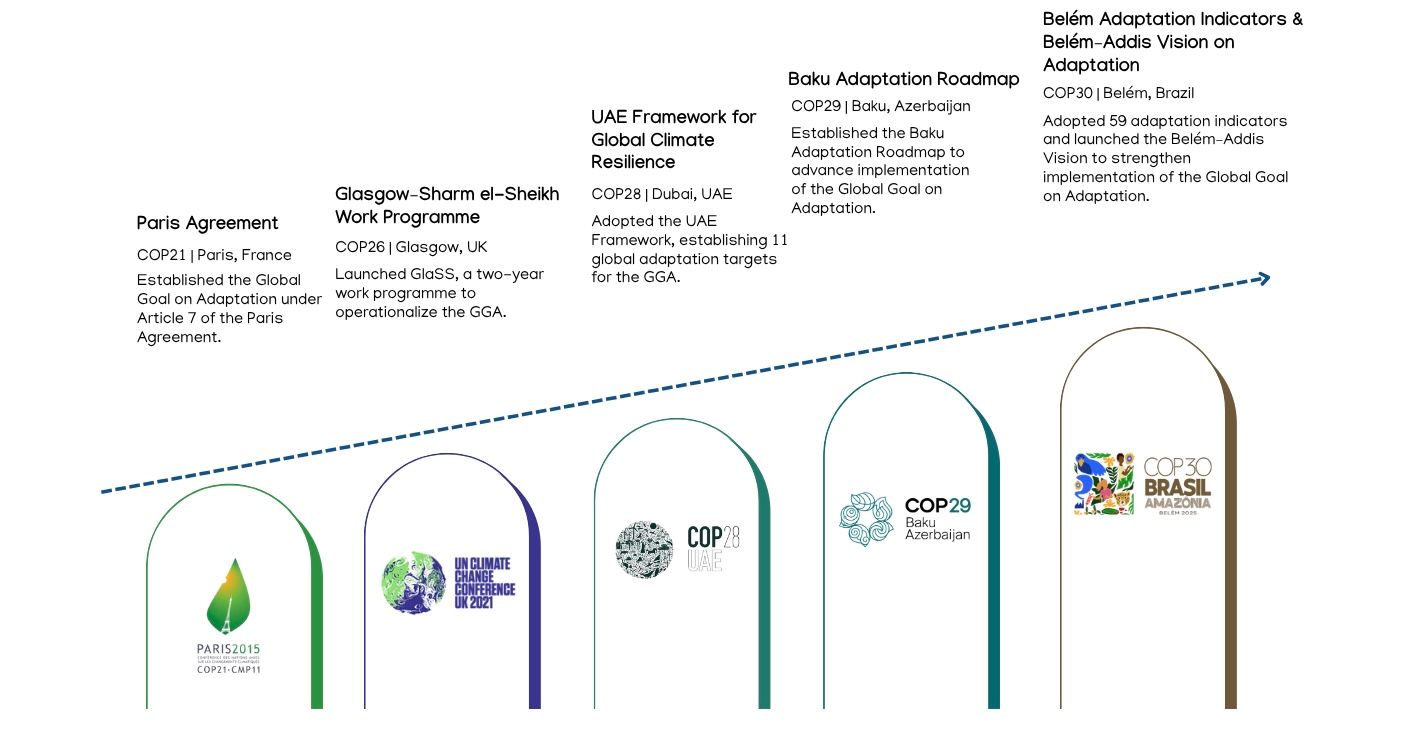
A major breakthrough came with the adoption of the Paris Agreement at COP21 in 2015. Through Article 7, Parties established the Global Goal on Adaptation, defining a shared objective to enhance adaptive capacity, strengthen resilience, and reduce vulnerability to climate change. For the first time, adaptation was recognized as a collective global endeavor rather than simply a series of national responses. Yet the Agreement answered only one part of the question of what the world sought to achieve. It left unresolved the equally important question of how progress toward that goal should be measured.
Between COP21 and COP26, the GGA remained more a political ambition than an operational framework. As climate impacts intensified, Parties recognized the need to define what adaptation success looks like and how it should be measured. This led to the establishment of the Glasgow–Sharm el-Sheikh Work Program (GlaSS) at COP26, a two-year process to develop methodologies, approaches, and indicators to assess collective adaptation progress. While it did not resolve these questions, it shifted negotiations from defining the GGA toward operationalizing it.
The next major turning point came at COP28 in Dubai, where Parties adopted the UAE Framework for Global Climate Resilience (UAE-FGCR). The framework transformed the GGA from a broad political aspiration into a more structured global architecture by establishing eleven adaptation targets spanning both thematic and dimensional targets. More importantly, it recognized that a global goal could only become operational if Parties could develop a credible, equitable, and technically robust approach to measuring progress.
Building on this foundation, negotiations continued through COP29 in Baku, where Parties launched the Baku Adaptation Road Map and advanced discussions on the technical and institutional arrangements needed to operationalize the GGA. However, the negotiations also demonstrated that developing adaptation indicators was never simply a technical exercise. Questions surrounding finance, equity, governance, and accountability became increasingly intertwined with discussions on measurement, reflecting broader differences over how adaptation should be implemented and supported under the Paris Agreement.
By the time Parties convened at COP30 in Belém, the central challenge had fundamentally changed. The question was no longer whether the Global Goal on Adaptation required a global framework; parties had already agreed that it did. The challenge had become how to operationalize that framework in a way that was scientifically credible, politically acceptable, and responsive to the diverse realities of countries. Belém would become the moment where the GGA began its transition from negotiated ambition to operational implementation.
COP30 Belém
COP30 in Belém marked a major milestone in the evolution of the Global Goal on Adaptation (GGA). Building on nearly a decade of negotiations under the Paris Agreement, Parties completed a significant phase of work under the UAE Framework for Global Climate Resilience (UAE-FGCR) by adopting the Belém Adaptation Indicators, the first globally agreed framework for assessing collective progress on adaptation.
Beyond the adoption of the indicators, Parties also launched the Belém–Addis Vision on Adaptation (BAVA), a two-year work programme designed to strengthen the technical foundations of the framework through methodological development, voluntary testing, and institutional learning ahead of COP32 in Addis Ababa. Together, these outcomes marked an important transition in the evolution of the GGA, from establishing a global adaptation framework to beginning its operationalization.
The Belém Adaptation Indicators
Measuring adaptation was never solely a technical exercise. Unlike mitigation, where progress can be assessed through standardized emissions metrics, adaptation is shaped by diverse national circumstances, climate risks, institutional capacities, and development priorities. As a result, negotiations over the Belém Adaptation Indicators became closely intertwined with broader questions of equity, governance, accountability, and finance.
Over two years, technical experts developed a comprehensive set of indicators aligned with the eleven targets of the UAE Framework for Global Climate Resilience. Through the UAE–Belém Work Programme, experts proposed a set of 100 indicators to support the operationalization of the framework. Following intensive negotiations at COP30, however, Parties ultimately adopted 59 Belém Adaptation Indicators, reflecting the political compromises required to achieve consensus.
The final decision also incorporated several safeguards to address concerns raised by developing countries. The indicators were explicitly defined as voluntary, non-prescriptive, non-punitive, and respectful of national circumstances. The decision further clarified that they cannot be used to compare countries, establish liability or compensation, create new financial obligations, or become conditions for accessing climate finance.
These safeguards proved essential to securing agreement. At the same time, they highlighted one of the defining challenges of the Global Goal on Adaptation: developing a scientifically credible measurement framework that remains equitable and responsive to the diverse realities of developing countries.
The Belém–Addis Vision on Adaptation (BAVA)
Recognizing that the adoption of the indicators marked the beginning rather than the completion of the process, Parties established the Belém–Addis Vision on Adaptation (BAVA) as a two-year work programme leading to COP32 in Addis Ababa. BAVA provides the framework for strengthening the practical application of the indicators through continued technical work, voluntary testing, and institutional learning.
A central component of BAVA is the establishment of a technical task force to develop the metadata and methodologies needed to operationalize the Belém Adaptation Indicators. Alongside this work, Parties are encouraged to voluntarily test the indicators, generating practical experience that can help refine methodologies, identify implementation challenges, and strengthen confidence in the framework over time.
Together, these workstreams were intended to translate the political agreements reached in Belém into an operational system capable of supporting implementation on the ground. With the framework established, attention shifted to SB64 in Bonn, where Parties faced the first major test of turning political agreement into implementation.
SB64 Bonn: The Challenges of Operationalizing Adaptation
SB64 in Bonn represented the first major test of the Global Goal on Adaptation following the decisions adopted at COP30 in Belém. Having agreed on the Belém Adaptation Indicators and launched the Belém–Addis Vision on Adaptation (BAVA), Parties entered Bonn with the task of translating political agreement into operational implementation.
While the adoption of the Belém Adaptation Indicators marked a major milestone, several questions remained unresolved. Concerns persisted around the technical robustness of the indicators, their alignment with the eleven GGA targets, and the need for further methodological development, testing, and refinement. Questions also emerged around governance and coordination, as multiple institutions and processes would need to work together to advance the implementation of the Global Goal on Adaptation.
The relationship between adaptation measurement and finance remained one of the most politically sensitive issues. Although the COP30 decision clarified that the indicators would not create new financial obligations, liabilities, or conditions for accessing climate finance, developing countries continued to emphasize that measuring adaptation progress must be accompanied by adequate means of implementation, including finance, technology transfer, and capacity building. For many vulnerable countries, progress on adaptation could not be separated from the resources needed to translate plans and commitments into on-the-ground action [8].
These unresolved questions became central to SB64 in Bonn, where Parties were expected to move the process from agreement toward implementation. The session represented the first major test of the Global Goal on Adaptation following the outcomes reached at COP30 in Belém. Having adopted the Belém Adaptation Indicators and launched the Belém–Addis Vision on Adaptation (BAVA), Parties arrived with the task of advancing the technical and institutional processes required to operationalize the framework.
Key expectations for Bonn included establishing the modalities and composition of the technical task force under BAVA, advancing work on metadata and methodologies for the 59 indicators, strengthening coordination across adaptation institutions, and improving links between the GGA, National Adaptation Plans (NAPs), finance mechanisms, and broader implementation processes. However, rather than simply advancing technical work, SB64 revealed that the transition from political agreement to implementation remained shaped by deeper disagreements over governance, finance, and the role of Parties in guiding the adaptation framework [9].
Bonn Revealed Two Structural Fault Lines
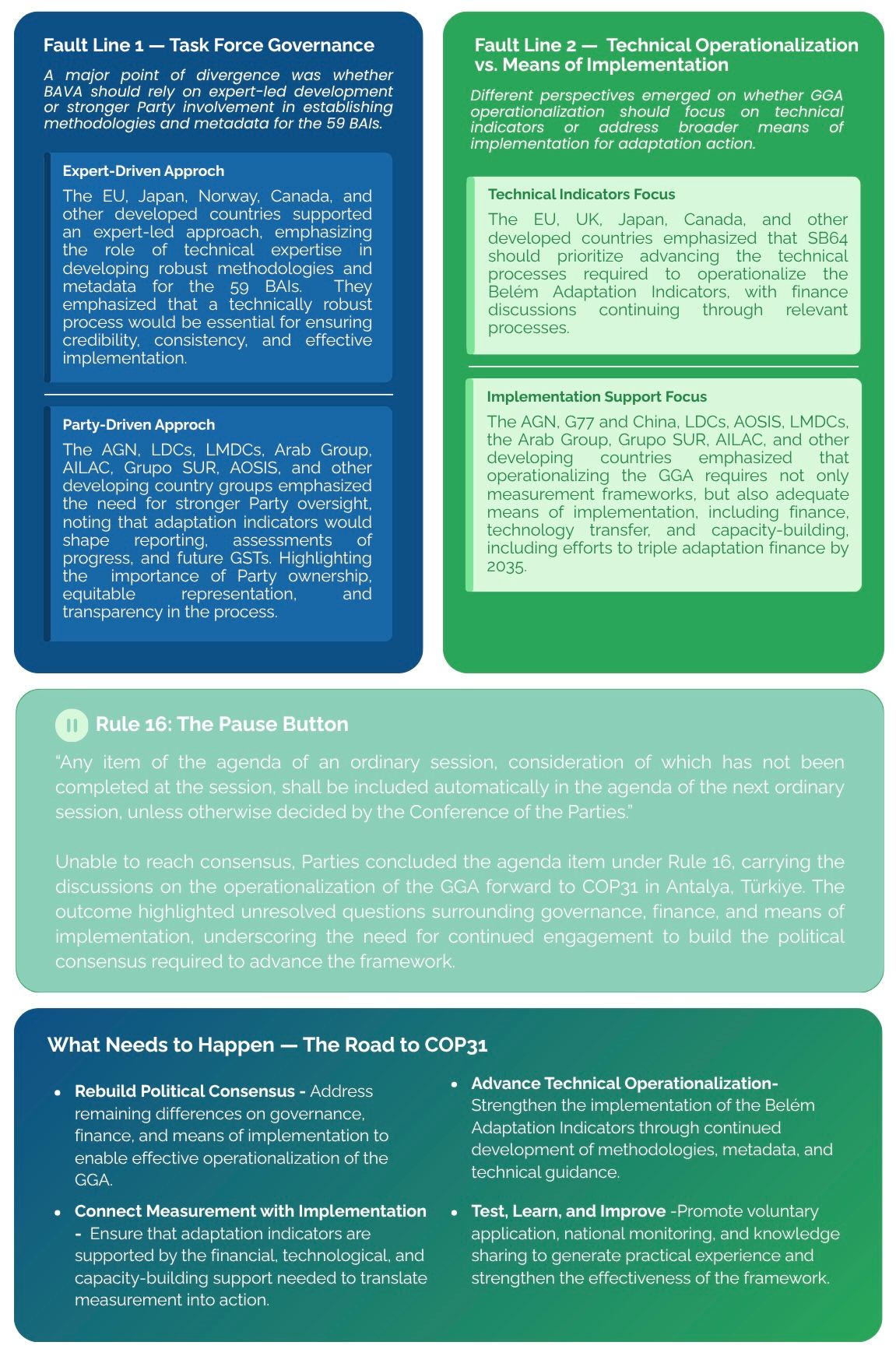
The first major disagreement concerned the Composition and Governance of the Technical Task Force under BAVA. While there was broad agreement that technical expertise was needed to develop methodologies and metadata for the indicators, Parties differed over who should guide this process. Several developed countries supported a more expert-driven approach focused on technical work, while many developing countries, including the African Group of Negotiators (AGN), the Least Developed Countries (LDCs), the Like-Minded Developing Countries (LMDCs), and other developing country groups, emphasized the need for stronger Party involvement. Their position reflected concerns that the indicators would influence national reporting, assessments of adaptation progress, and future discussions under the Global Stocktake. Despite efforts to identify compromise options, including hybrid arrangements combining technical expertise with Party oversight, Parties were unable to reach consensus.
The second and more politically significant disagreement concerned Adaptation Measurement and Adaptation Finance. Developing countries emphasized that operationalizing the GGA could not be separated from the financial, technological, and capacity-building support required to implement adaptation action. They called for recognition of existing commitments, including efforts to triple adaptation finance by 2035, and argued that meaningful measurement of adaptation progress must be accompanied by adequate means of implementation.
Developed countries, however, maintained that finance discussions should remain within relevant finance processes and argued that SB64 should focus primarily on the technical implementation of the indicators. This difference reflected a broader divide over whether adaptation measurement should be treated as a standalone technical exercise or as part of a wider implementation framework supported by finance and equity considerations.
Rule 16: Deferring the Negotiations to COP31
Unable to bridge these differences, Parties concluded the agenda item under Rule 16 of the draft Rules of Procedure. Rule 16 applies when Parties cannot reach consensus before the end of a negotiating session. Rather than adopting conclusions or forwarding agreed negotiating text, the issue is carried forward to the next ordinary session.
For the GGA, the application of Rule 16 meant that discussions on operationalizing the framework were deferred to COP31 in Antalya, Türkiye. The absence of an agreed outcome from SB64 means that Parties will resume negotiations without a finalized basis for implementation, making it more challenging to rebuild consensus.
The outcome in Bonn represented more than a procedural delay. It exposed the unresolved political tensions surrounding adaptation governance, finance and implementation. While technical work under BAVA and broader adaptation activities will continue, COP31 will be tasked with rebuilding the political consensus needed to move the Global Goal on Adaptation from agreed framework to effective implementation.
The Youth Print Perspective
The outcome in Bonn was undoubtedly a setback for the Global Goal on Adaptation, but it should not be interpreted as a setback for the adaptation agenda itself. Multilateral climate negotiations have repeatedly progressed through periods of deadlock before delivering major breakthroughs, and the adoption of the Belém Adaptation Indicators was itself the product of years of complex negotiations. The invocation of Rule 16 delayed progress, but it did not reverse the decisions adopted in Belém, nor did it diminish the urgency of strengthening adaptation in a world already experiencing escalating climate impacts.
More importantly, Bonn demonstrated that the Global Goal on Adaptation has entered a new phase. The central challenge is no longer defining adaptation or designing a global measurement framework. Those foundations have largely been established. The challenge now is building the political consensus required to operationalize that framework.
The debates over the technical task force reflected broader questions of governance, finance, equity, and the means of implementation. These are not parallel discussions; they are increasingly becoming the defining questions of adaptation governance. Unless greater confidence is built between developed and developing countries on these issues, technical progress alone is unlikely to deliver meaningful implementation.
Looking ahead to COP31 and beyond, the period between political agreement and practical implementation should be viewed as an opportunity rather than a pause. Voluntary testing of the Belém Adaptation Indicators, continued methodological development, stronger national monitoring and learning systems, and the sharing of implementation experiences can help strengthen both the evidence base and confidence in the framework.
The journey from Belém to Bonn illustrates an important lesson for the future of the Global Goal on Adaptation. Operationalizing adaptation will depend not only on stronger indicators, but on stronger political trust. Ultimately, the success of the GGA will be measured not by the sophistication of its framework, but by its ability to support countries in building resilience where it matters most.
Looking Ahead
The decisions adopted in Belém and the discussions in Bonn represent only one stage in the evolution of the Global Goal on Adaptation. As negotiations continue toward COP31 in Antalya and COP32 in Addis Ababa, attention will increasingly shift from negotiating frameworks to demonstrating implementation.
For policymakers, negotiators and practitioners, the challenge will be to ensure that the political ambition embodied in the Global Goal on Adaptation is matched by the governance arrangements, financial support and institutional capacity needed to deliver resilience on the ground.
The road from Belém to Bonn, and beyond, therefore marks not the conclusion of the adaptation agenda, but the beginning of its implementation era.
Reference
- United Nations (2015) Paris Agreement.
- UNFCCC (2021) Glasgow–Sharm el-Sheikh work programme on the global goal on adaptation. Decision 7/CMA.3. Bonn.
- UNFCCC (2023). UAE Framework for Global Climate Resilience. Decision 2/CMA.5. Dubai.
- UNFCCC (2024). Baku Adaptation Road Map. Decision 3/CMA.6. Baku.
- UNFCCC (2025) Final list of potential indicators, UAE–Belém work programme on indicators. Bonn
- UNFCCC (2025) Global goal on adaptation. Draft decision -/CMA.7. Proposal by the President. FCCC/PA/CMA/2025/L.25. Bonn
- International Institute for Sustainable Development (IISD). (2026). Earth Negotiations Bulletin: Bonn Climate Change Conference (SB64) Final Summary. Winnipeg
- The Youth Print. (2026). SB64 Week 1 Review: The Youth Print Briefing — Assessing Emerging Trends and Negotiation Trajectories Toward COP31. Addis Ababa
- The Youth Print. (2026). SB64 Final Assessment: The Youth Print Briefing — Signals for COP31 and the Politics of Climate Implementation. Addis Ababa.
- UNFCCC (1996). Draft Rules of Procedure of the Conference of the Parties and Its Subsidiary Bodies. FCCC/CP/1996/2. Bonn
What we recommend
Assign a named owner and a review date to every minuted recommendation, before the session closes.
Fund one dedicated coordinator per consultative body — a shared post is the single largest point of failure we found.
Publish a public tracker of recommendations and their status, so delegates leaving after one term hand over a record rather than a memory.
Pay young delegates for preparation time, or accept that only those who can afford to work unpaid will hold the seats.