
Introduction
The year 2025 continued to reflect the accelerating impacts of climate change across the globe. Global temperatures remained among the highest on record, greenhouse gas concentrations reached new peaks, and the world’s oceans absorbed unprecedented amounts of heat. At the same time, extreme weather events, including heatwaves, floods, droughts, wildfires, and severe storms, affected millions of people, disrupted ecosystems, and placed increasing strain on communities in every region.
These developments underscore a clear reality in which climate change is now a present-day challenge with wide-ranging implications for human health, food security, water availability, livelihoods, and economic stability. The events of 2025 provide further evidence of a climate system under continued pressure, with growing exposure of societies and ecosystems to climate-related risks.
This publication provides a concise summary and analysis of the State of the Global Climate 2025, the World Meteorological Organization’s (WMO) annual flagship report on the condition of the Earth's climate system. The report presents key indicators including global temperature, greenhouse gas concentrations, ocean heat content, sea level rise, sea-ice extent, glacier mass balance, and the newly introduced measure of Earth’s energy imbalance. It also documents major weather and climate events from around the world, providing a comprehensive overview of global climate conditions.
2025 in Numbers
Global Temperature
The global mean surface temperature in 2025 was 1.43°C ± 0.13°C above the 1850–1900 average according to the WMO assessment, making it one of the warmest years on record. This warming trend is consistent with long-term observations showing a steady increase of approximately 0.2°C per decade, driven largely by human activities.
Rising temperatures are affecting ecosystems, agriculture, and human health while also increasing the likelihood and intensity of extreme weather events. The continued warming observed in 2025 reinforces concerns about the growing impacts of climate change on both natural and human systems.
Greenhouse Gases
Atmospheric concentrations reached record levels, with carbon dioxide (CO₂) at 423.9 ± 0.2 parts per million (ppm), methane (CH₄) at 1,942 ± 2 parts per billion (ppb), and nitrous oxide (N₂O) at 338.0 ± 0.1 ppb. These greenhouse gases trap heat in the atmosphere and remain the primary drivers of long-term global warming.
CO₂ concentrations are now higher than at any point in at least 2 million years, while methane and nitrous oxide are at their highest levels in at least 800,000 years. The continued increase in greenhouse gas concentrations demonstrates that the underlying drivers of long-term global warming remain firmly present.
Sea Level Rise
Global mean sea level continued to rise rapidly. During 2012–2025, sea level rose at an average rate of 4.75 mm per year, compared with 2.65 mm per year during 1993–2011.
Ocean heat content also reached its highest level on record in 2025, reflecting the ocean’s critical role in absorbing excess heat from the climate system. Together, continued ocean warming and sea level rise increase risks for coastal communities, low-lying islands, infrastructure, and ecosystems.
Cryosphere Changes
The cryosphere, which includes glaciers, ice sheets, and sea ice, continued to experience significant changes in 2025. Arctic sea ice remained at historically low levels, while glaciers continued to lose mass globally.
Both the Greenland and Antarctic ice sheets also experienced continued mass loss. These changes contribute to sea level rise and demonstrate the sustained response of frozen parts of the Earth system to a warming climate.
Taken together, these indicators reveal a climate system experiencing persistent and systemic change. The climate extremes documented throughout 2025 occurred against this broader background of rising temperatures, increasing greenhouse gas concentrations, and continued ocean warming. The findings reinforce the importance of strengthening both mitigation and adaptation efforts as climate-related risks increase.
Climate Extremes
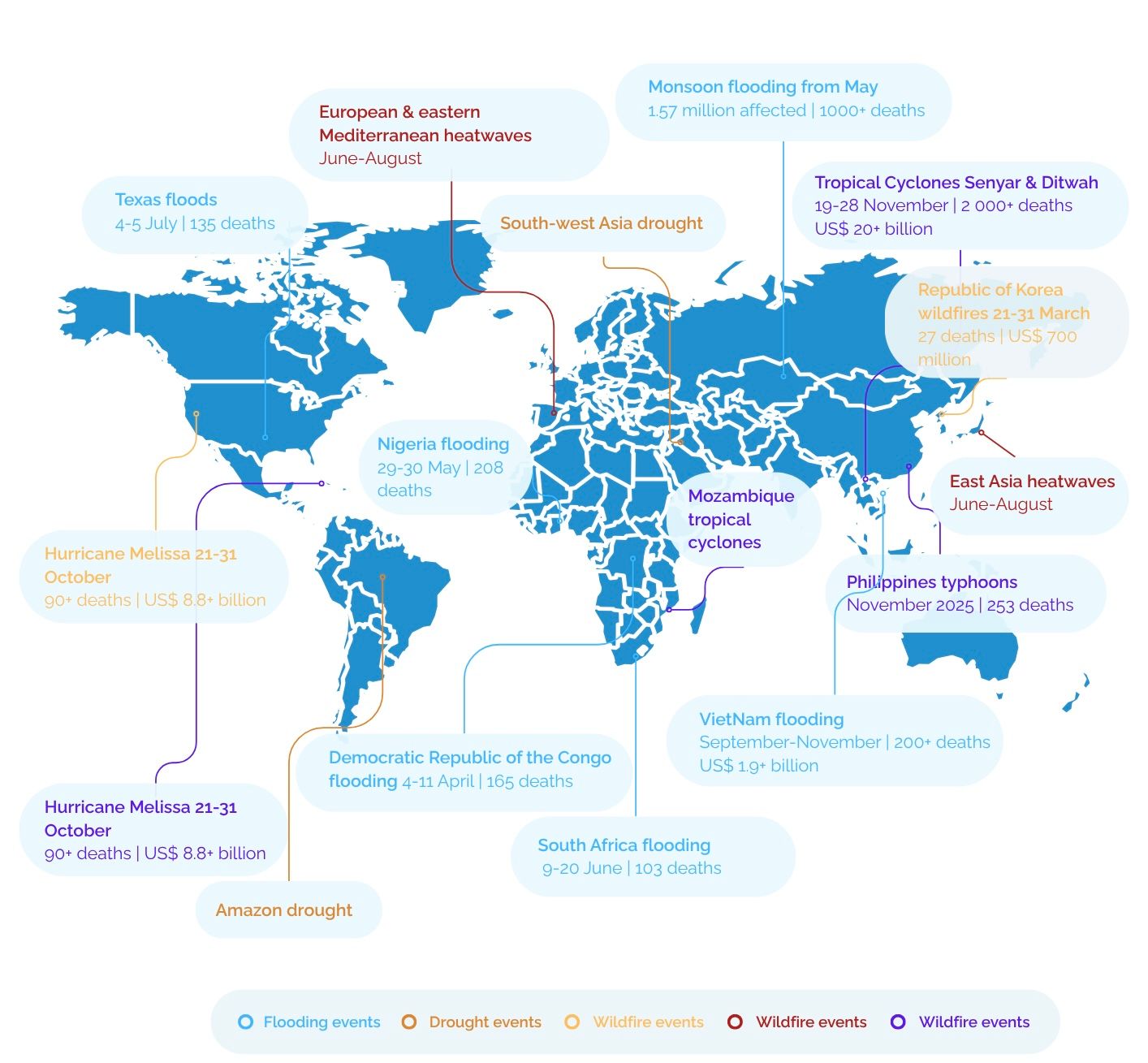
The events documented in 2025 illustrate the escalating risks associated with climate change and exposure. The events resulted in significant human, economic, and environmental losses and demonstrate how climate hazards can interact with exposure and vulnerability.
Heatwaves
Record-breaking temperatures affected several regions during the year. Portugal recorded temperatures of 46.6°C, Spain reached 46.0°C, and Türkiye experienced temperatures of 50.5°C. East Asia also experienced its hottest summer on record, with Japan reaching 41.8°C in Isesaki.
These extreme heat events contributed to widespread wildfires, including more than 390,000 hectares burned in Spain, and led to significant displacement across parts of Europe, Türkiye, Greece, and East Asia. The increasing severity of heatwaves highlights the growing risks posed by rising temperatures to both human populations and ecosystems.
Wildfires
Prolonged heat and dry conditions intensified wildfire activity across multiple regions. California’s Eaton and Pacific Palisades fires destroyed more than 16,000 structures, caused over 30 deaths, displaced approximately 260,000 people, and resulted in US$60 billion in losses, representing the largest wildfire economic loss recorded.
In the Republic of Korea, historic wildfires caused 27 deaths and approximately US$700 million in damages. These events illustrate how climate-related hazards can rapidly escalate into major humanitarian and economic crises.
Floods
Intense rainfall triggered devastating floods in several regions. Texas experienced flash floods associated with up to 500 mm of rainfall within a matter of hours, resulting in 135 deaths.
Meanwhile, Nigeria, the Democratic Republic of the Congo, South Africa, and Viet Nam experienced floods that collectively caused hundreds of fatalities and billions of dollars in damages. These events highlight the increasing scale and unpredictability of extreme precipitation and its consequences for communities and infrastructure.
Droughts
Severe drought conditions persisted across the Amazon basin and parts of South-West Asia. Türkiye recorded its driest year since 1964, while areas of Iran, Syria, and Jordan experienced rainfall deficits of 50% or more.
The resulting water shortages and reduced cereal production underscored the growing pressure that climate-related drought places on water resources, agriculture, and food security.
Cyclones and Tropical Storms
Warmer ocean temperatures continued to provide favorable conditions for stronger tropical storms. Cyclones Dikeledi and Jude affected more than 1.3 million people in Mozambique and Madagascar.
Hurricane Melissa caused more than 90 deaths in the Caribbean, displaced approximately one million people, and generated US$8.8 billion in damages. In Southeast Asia, Cyclones Senyar and Ditwah resulted in more than 2,000 deaths and US$20 billion in losses, while Philippine typhoons Kalmaegi and Fung-Wong displaced over 500,000 people.
Collectively, these events demonstrate the increasing exposure and vulnerability of communities worldwide to climate-related hazards. They also reinforce the importance of investing in early warning systems, resilient infrastructure, disaster preparedness, and climate adaptation measures.
Climate Drivers
Climate drivers are the underlying forces shaping the rapid changes observed across the global climate system in 2025. They help explain why temperatures continue to rise, why glaciers and ice sheets are losing mass, and why climate-related hazards can produce increasingly significant impacts.
While natural processes continue to influence climate variability, human activities remain the dominant driver of long-term climate change. Understanding these drivers is essential for informing effective mitigation and adaptation strategies.
Greenhouse Gas Emissions
The combustion of fossil fuels, industrial activities, and certain agricultural practices continue to release large quantities of carbon dioxide, methane, and nitrous oxide into the atmosphere. These greenhouse gases trap heat and remain the primary cause of global warming.
Land Use Change
Deforestation, agricultural expansion, and urban development continue to reduce the Earth's natural capacity to absorb carbon. The loss of forests and wetlands not only weakens important carbon sinks but can also increase vulnerability to floods, droughts, and other climate-related hazards.
Feedback Loops
As temperatures rise, certain natural processes can amplify warming further. For example, melting polar ice reduces the Earth's ability to reflect sunlight, while thawing permafrost releases additional greenhouse gases into the atmosphere. Warmer oceans can also contribute to stronger storms and more intense heatwaves.
Ocean Dynamics
The world's oceans absorb both excess heat and carbon dioxide from the atmosphere. While this process helps moderate atmospheric warming, it contributes to ocean warming, sea level rise, ocean acidification, and changes in weather patterns that affect marine ecosystems, fisheries, and coastal communities.
These climate drivers show that tackling climate change requires urgent mitigation, sustainable land management, and policies that build resilience for communities most affected by these shifts. They also demonstrate the interconnected nature of climate systems, where one change can trigger a chain reaction of impacts across ecosystems and societies.
Key Findings
1. The global climate system continued to warm in 2025.
Multiple key indicators including global temperature, greenhouse gas concentrations, ocean heat content, sea level rise, and cryosphere conditions confirm that the Earth’s climate system continues to warm. This reinforces climate change as a persistent and defining global challenge.
2. Greenhouse gas concentrations reached record levels.
Carbon dioxide, methane, and nitrous oxide continued to increase in the atmosphere, remaining the primary drivers of long-term global warming. This confirms that the underlying causes of climate change remain fundamentally unchanged.
3. Oceans and cryosphere systems are under sustained stress.
Ocean heat content, rising sea levels, continued glacier retreat, ice-sheet mass loss, and declining Arctic sea ice extent indicate increasing pressure on ocean and frozen systems. These changes have long-term implications for ecosystems, coastal stability, and global climate regulation.
4. The events documented in 2025 illustrate escalating climate risks.
Heatwaves, wildfires, floods, droughts, and tropical storms affected millions of people in 2025, causing significant human, economic, and environmental losses. These events demonstrate how climate hazards can interact with exposure and vulnerability to produce severe consequences.
5. Climate risks and vulnerabilities remain widespread.
The scale of impacts observed in 2025 highlights continued exposure of communities, infrastructure, and livelihoods to climate risks, particularly in regions with limited adaptive capacity and resilience.
6. Adaptation is increasingly critical but unevenly implemented.
The scale and severity of climate impacts underscore the urgent need for adaptation measures such as early warning systems, resilient infrastructure, disaster preparedness, climate-smart agriculture, and improved water management. However, implementation capacity remains uneven, leaving vulnerable populations disproportionately exposed.
7. Climate impacts are interconnected and mutually reinforcing.
Rising temperatures, greenhouse gas concentrations, ocean warming, sea level rise, and extreme weather events are closely linked and often amplify one another, producing cascading impacts across natural and human systems.
8. Human activities remain the dominant driver of climate change.
Fossil fuel use, land-use change, and other human activities continue to drive observed climate trends, while internal feedback mechanisms within the climate system further intensify warming.
The Youth Print Perspectives
The evidence from 2025 points to a climate system undergoing persistent and systemic change, with warming reflected across temperatures, greenhouse gas concentrations, oceans, sea levels and the cryosphere. These changes suggest that climate risks are no longer isolated events, but increasingly part of the conditions within which societies, economies and ecosystems operate. This calls for climate responses that recognise the scale, interconnectedness and long-term nature of these changes.
The extreme events observed throughout the year further demonstrate how climate risks can interact and compound existing vulnerabilities, affecting livelihoods, ecosystems, infrastructure, food and water security, and economic stability. For Africa, where climate impacts often intersect with existing development challenges, this reinforces the importance of strengthening adaptation, early warning systems, anticipatory action and climate-informed development.
These developments point toward the need for climate action that is systemic, coordinated and forward-looking, combining efforts to address the drivers of warming with stronger approaches to adaptation and resilience. This means strengthening the connection between climate knowledge, preparedness and implementation, while ensuring that young people and communities are meaningfully positioned within the systems shaping climate responses and resilient development.
Sources and Editorial Approach
This independent briefing synthesises findings from the World Meteorological Organization (WMO), State of the Global Climate 2025 (WMO-No. 1391, 2026), https://doi.org/10.59327/WMO/S/CRI/SOC/1. All analysis and interpretation are those of The Youth Print. This publication is not an official WMO publication and does not imply WMO endorsement.